Wednesday, January 25, 2017

teaching and engagement

So day one of my org behavior class where I am trying to use open education principles to run the class.


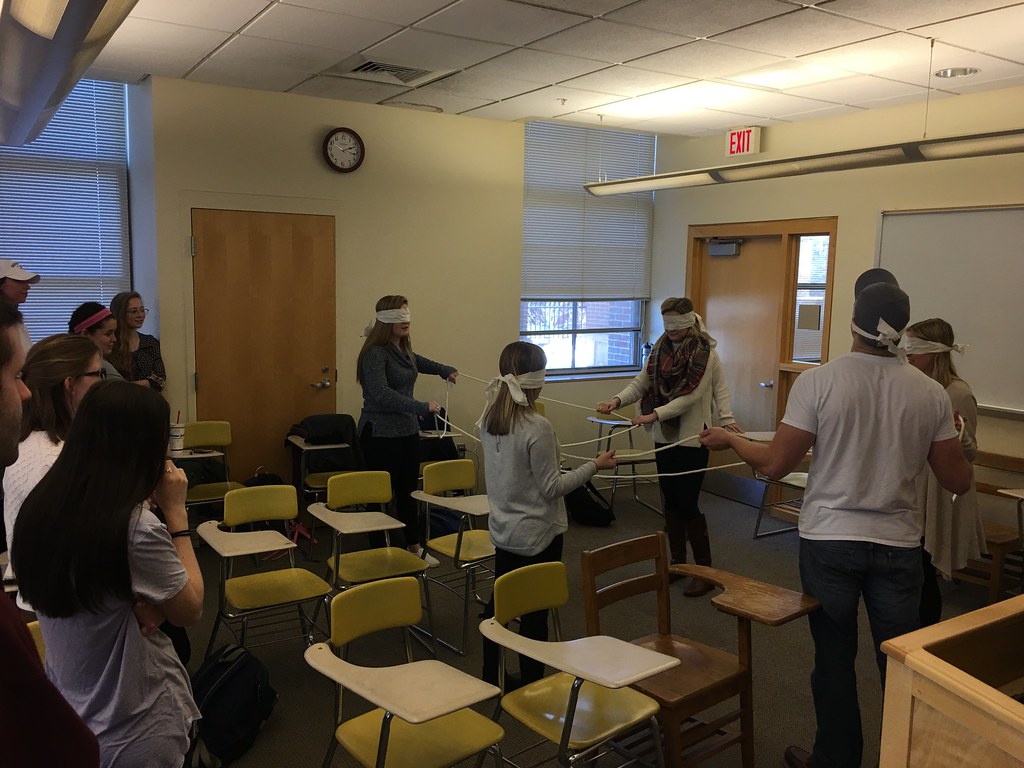
Here they are working through a warm up exercise where they had to contain a reactor meltdown after a tsunami hit the New Hampshire seacoast. Of course they had to wear protective gear while they were so close to the radiation. Luckily they had audio communications with the rest of their team.

I have been drawn to open education primarily because I see it as an opportunity for greater engagement - for the students, and for me.

Unfortunately, I spent most of the class talking at the students about the class. I had hoped to actually have some conversation, but we had relatively little. That's me, reverting to "sage on the stage" type. This is not going to be easy.

They did make decisions about how to assign mentors. It was somewhat arbitrary, but I suppose that is partially because I rushed the issue. Lesson learned there.

Turning the controls over to the students is going to be a challenge for both them and me. I'm still looking forward to the opportunity!


here we go again!

Spring semester starts for me a couple of minutes and I am, as always, excited and nervous for the first day of class. This semester I am trying something completely different - an experiment with Open Education as I have noted previously - so I am excited to try something completely different and a little nervous that it is going to be an epic fail. But that's the nature of innovation - you have to take chances.

As the Army Core of Engineers says, Essayons! Let us try!

Friday, January 13, 2017

article summary: Attributes of Open Pedagogy - A Model for Using Open Educational Resources

For my ongoing article a day for 30 days effort - day 13:
Bronwyn Hegarty, Attributes of Open Pedagogy: A Model for Using Open Educational Resources
https://upload.wikimedia.org/wikipedia/commons/c/ca/Ed_Tech_Hegarty_2015_article_attributes_of_open_pedagogy.pdf
I've chosen this article because I have decided to try "open pedagogy" for my OB class this spring. I'll be looking at a number of articles about employing this educational approach.

Notes:

“Open Educational Practices (OEPs) constitute the range of practices around the creation, use, and management of open educational resources with the intent to improve quality and innovate education” (OPAL, 2011a, p. 4)
Five principles of openness are considered by Conole (2013) to be necessary for OEP, comprising open tools and processes that promote:
(1) collaboration and sharing of information;
(2) connected communication about learning and teaching;
(3) collectivity to grow knowledge and resources;
(4) critique for the promotion of scholarship; and
(5) serendipitous innovation. (Conole, 2013)
 Attributes of Open Pedagogy
1) Participatroy technologies
2) People, openness, trust
3) Innovation and creativity
4) Sharing ideas and resources
5) Connected community
6) Learner generated
7) Reflective practice
8) Peer review

Thursday, January 5, 2017

more trait theory stuff

This looks like an interesting site. Connected to Northwestern University's Personality, Motivation, and Cognition Laboratory.

https://sapa-project.org/

Haven't taken the test yet. Anyone else?

trait theory web site

Here's a trait theory site with a free test:

http://www.outofservice.com/bigfive/

The Meyers-Briggs (MBTI) is based on preference theory. I happen to like the Meyers-Briggs personally, probably because I've used it and thought about it so much. But psychologists tend to poo-poo it in favor of trait theory and the "Big Five".

Here is the basic difference:
The essential difference between the trait theory and type theory is this: type theory views characteristics of people as discrete categories whereas trait theory views these same characteristics as part of a larger continuum. For example, where a type theorist would claim that introverts and extroverts are two types of people, a trait theorist would claim there is a gradient leading from introversion to extroversion and it is possible for individuals to fall somewhere in the middle. 
from: http://blog.motivemetrics.com/Psychological-Traits-vs-Personality-Type-Theory  

I recently read a book based on the Big Five - Me, Myself, and Us by Brian Little. Very good. A bunch of fun exercises to test your placement.

fun Meyers-Briggs personality sites

I'm getting ready to teach and OB/Leadership course and the first thing we are going to do is the Meyers-Briggs type indicator.

Here is a free online version of the MBTI:

https://www.16personalities.com/free-personality-test


I found this web site and I really like it as a resource.

http://personality-types.careertrends.com/

Criticism of Meyers-Briggs: https://sapa-project.org/dmc/blog/myersbriggs.html


Tuesday, December 27, 2016

Social Valorization Theory

I am working with some colleagues on a research project that will rely on Social Role Valorization Theory or SRV. A good overview of the theory can be found at:  http://www.srvip.org/overview_SRV_Osburn.pdf

I was not familiar with the concept. A few useful quotes:
The application of empirical knowledge to the shaping of the current or potential social roles of a party (i.e., person, group, or class) -- primarily by means of enhancement of the party’s competencies & image -- so that these are, as much as possible, positively valued in the eyes of the perceivers  (Wolfensberger & Thomas, 2005).
all sorts of good things that other people are able to convey are almost automatically
apt to be accorded to a person who holds societally valued roles, at least within the resources and norms of his/her society... To mention only a few major examples, they include being accorded dignity, respect, acceptance; a sense of belonging; an education, and the development and exercise of one’s capacities; a voice in the affairs of one’s community and society; opportunities to participate; a decent material standard of living; an at least normative place to live; and opportunities for work and self-support. 
Devalued individuals, groups, and classes are far more likely than other members
of society to be treated badly, and to be subjected to a systematic -- and possibly lifelong -- pattern of such negative experiences as the following.
1. Being perceived and interpreted as “deviant,” due to their negatively-valued differentness.
The latter could consist of physical or functional impairments, low competence, a particular ethnic identity, certain behaviors or associations, skin color, and many others.
2. Being rejected by community, society, and even family and services.
3. Being cast into negative social roles, some of which can be severely negative, such as “subhuman,” “menace,” and “burden on society.”
Being put and kept at a social or physical distance, the latter most. Also, when a person holds valued social roles, attributes of theirs that might  otherwise be viewed negatively are much more apt to be put up with, or overlooked, or “dismissed” as relatively unimportant.
The article goes on to talk about action steps to work with groups on increasing their social recognition.

It's an interesting theory, and I tend to concur with it. I shared with my group a couple of quotes from Adam Smith's The Theory of Moral Sentiments that share the same conclusions (albeit from a couple of hundred years ago and using slightly different language):

Our obsequiousness to our superiors more frequently arises from our admiration for the advantages of their situation, than from any private expectations of benefit from their good–will. Their benefits can extend but to a few; but their fortunes interest almost every body. We are eager to assist them in completing a system of happiness that approaches so near to perfection; and we desire to serve them for their own sake, without any other recompense but the vanity or the honour of obliging them.”
The poor man, on the contrary, is ashamed of his poverty. He feels that it either places him out of the sight of mankind, or, that if they take any notice of him, they have, however, scarce any fellow–feeling with the misery and distress which he suffers. He is mortified upon both accounts; for though to be overlooked, and to be disapproved of, are things entirely different, yet as obscurity covers us from the daylight of honour and approbation, to feel that we are taken no notice of, necessarily damps the most agreeable hope, and disappoints the most ardent desire, of human nature. The poor man goes out and comes in unheeded, and when in the midst of a crowd is in the same obscurity as if shut up in his own hovel.
http://oll.libertyfund.org/titles/2620#lf1648_label_116


What I liked about the superior passage is the idea that we have a natural inclination to serve those who are in the valued classes/groups. I thought it nicely echoes Osburn’s statement, “all sorts of good things that other people are able to convey are almost automatically apt to be accorded to a person who holds societally valued roles, at least within the resources and norms of his/her society” (or really, Osburn echoes Smith and other thinkers). We give willingly to the valued even if they have done nothing to earn it, and likewise, the poverty quote shows how the needs of the non-valued classes are completely ignored.


Wolfensberger, W., & Thomas, S. (2005). Introductory Social Role Valorization workshop training package. Syracuse, NY: Training Institute for Human Service Planning, Leadership and Change Agentry (Syracuse University).