Saturday, February 11, 2017

theories of multiple intelligences

One pair of students in my OB course is going to talk about emotional intelligence. Here's a link to Caroline's introductory post: https://hmp722cs.blogspot.com/2017/02/emotional-intelligence.html

I haven't done that much reading on the topic, so I'll be interested to see what they come up with for resources. I concur with the essential concept - the best leaders I know are smart, but aren't necessarily the highest IQ people I know. And a lot of high IQ people I know are not great leaders. 

Thinking about IQ and EQ reminded me of some other research on intelligence that I have read about, so I grabbed this link on 7 intelligences by Howard Gardner: http://www.tecweb.org/styles/gardner.html

Friday, February 3, 2017

Essayons! Org Behavior taught with Open Education Philosophy

This semester I have decided to adopt an open education philosophy toward my org behavior course. The course syllabus is here:

https://docs.google.com/document/d/10WkZnIvPgZpJrcCZJaaX7QeE6VGCvc4RQxsz3Z6vC64/edit?usp=sharing

In a nutshell, the course will operate like this: I have explained to the students that within a broad framework, they will run the class. The will organize the lecture periods, and they will collectively decide on what is covered in class.

The ultimate goal of the class, and the final, group deliverable, is to produce a primer (text book) on organizational behavior and leadership aimed at early careerist healthcare leaders - i.e., people like them.

They are also required to document their journey by creating an individual portfolio. Most of them have chosen to create a blog as the backbone of the portfolio (my suggestion). I am hoping they branch out into multi-media as well, but we'll see.

I have not left them hanging, though. I have recruited a cadre of volunteer mentors from students I taught in MHA and MBA programs before I arrived at UNH. All of these mentors are now healthcare executives with advanced degrees in management, and in some cases, advanced degrees in other subjects as well. Each student has selected a mentor and is required to have three synchronous conferences with their assigned mentor over the course of the semester, one at each turning point in the course. The course is organized into three parts based on general subject theme - the individual, the interpersonal, and the organizational. They have been instructed to consult with their mentor on what the mentor would recommend they study for each part to be successful as a healthcare executive.

Of course, I am available to the students throughout, and more than happy to give them ideas and resources. But what they do is going to be up to them.

As of Wednesday, our third class meeting, the students have begun to take charge. I am extremely pleased with the progress they made in that class. They re-wrote the schedule, and divided it up.

They have all begun blogging. You can see their blogs here:


http://ermhmp722.blogspot.com/
http://hmp722elk.blogspot.com/
http://hmp722jl.blogspot.com/
http://carlybarber.blogspot.com/
http://hmp722cs.blogspot.com/
http://hmp722sm.blogspot.com/
http://reganjudge.blogspot.com/
https://traitsandbehavior.blogspot.com/
http://jessfuccihmp722.blogspot.com/
http://healthcaremanagementideas.blogspot.com/
http://meghanpinkham.blogspot.com/
http://hmp722unh.blogspot.com/
http://mgmt722.blogspot.com/
http://letmemakeableg.blogspot.com/

They are in the process of having their first meetings with their mentors, and next week they will finalize topics for the first round of classes.

I have the College of Health and Human Services librarian coming next week to give a brief overview of how to access the databases in the library so that they have her as a mentor as well.

In a world where they have more information in their pocket (in the form of a smartphone) than any other human beings who walked the earth since the beginning of time, what's the point of me lecturing them? The most important thing to learn from an OB class is how to work with and lead others. You can read about that, but if you don't do it, you aren't really going to learn it.

I gave them the French word, Essayons! as a theme for this course. It is the motto of the Army Corps of Engineers, and it means, Let us Try! 

A student asks, what the hell is going on?

One of my students honestly poses the question of what the hell is going on in this class? He doesn't say "hell" - he's too polite - what he actually says is:
This class is very different than any other class I have ever taken in my academic career. The class is structured in a way that allows the students to determine and teach the content of the course, rather than having the Professor lead the class. Not gonna lie I am still hesitant about the class, however I know that it is going to be a unique experience and believe that it will help me develop into a future professional of the healthcare industry.
 rest here: https://hmp722unh.blogspot.com/2017/01/hmp-722.html

So my comment back:

Interesting question, what does it mean to "lead"? Have I abdicated my responsibility?

In a world where you have, in the form of a smart phone in your pocket, access to more information instantly than any other human being who lived before 2008, or if you want to date it back to commercial access to the internet in 1995 or so, what does it mean to teach?

I did my dissertation on the thinking of Adam Smith, the founder of modern economic thought. One of the books I had access to was a compilation of student notes from his classes on moral philosophy. Smith would literally come to class and read to the students from his notes, and they would copy them down. That was teaching in 1750. He was very popular as a teacher. Does that even make sense in today's era of smartphones?

How much sense does it make to assign a text book today when the information is out there, and one of the key managerial skills of today (not the future) is to pull information together and create a coherent vision of the environment and the opportunities in it?

That's where I'm coming from. You guys may not cover as much material as you could have if I was the one telling you what to read, but even if we did that format, there would be limits of how much we could cover. When I was doing my MBA in org behavior, I took a whole class on "self leadership". I took another whole semester course on theories of leadership. What I'm saying is, even if I dictated to you what to read, we would only be scratching the surface of a huge field. So if you get to a little less material than you would have, I'm not sure the loss is that great. The question is, at the margin, will you gain more knowledge about leadership and organizational behavior by trying to collectively run an organization than you would have if I had pushed more material at you to read? If the former is more beneficial, at the margin, then the course will have been a success.

I'm glad you're willing to try, though!

Saturday, January 28, 2017

a domain of their own

This semester I am requiring my students to start working in public. I'm trying to adopt principles of open pedagogy - an educational philosophy that calls for sharing ideas freely, and for doing so in a manner that engages the student with the world.

It appears UMW is also embracing the concept - giving students their own domain name where they can put their work on public display, creating a portfolio. Here's a nice article from one of their students about the experience, and what makes it work:

https://brightreads.com/the-web-we-need-to-give-students-311d97713713#.ld613alrf

I'm calling my requirement a "portfolio". I've shown the students how to set up a blog, and I've suggested they use the blog format to document their journey, but I am not requiring they use a blog. What I told them was they could use a blog or some other web-based technology, so long as the work was in the public sphere. I've also told them they can do it anonymously - they don't have to use their real names.

I like this quote from the article:
And then — contrary to what happens at most schools, where a student’s work exists only inside a learning management system and cannot be accessed once the semester is over — the domain and all its content are the student’s to take with them. It is, after all, their education, their intellectual development, their work.
The key, though is for the work to be meaningful. One of the principles of open pedagogy is to not assign work that is thrown away at the end of the semester. The standard, "Write me a 2-3 page paper about what chapter 7 says" is an example of an expendable assignment. It is strictly an exercise not meant for retention.

I am hopeful that the process of building a portfolio of reflections is a worthwhile process. I am afraid that they are so used to the disposable, check the block kind of assignments that they will not be able to embrace this idea.

Wednesday, January 25, 2017

teaching and engagement

So day one of my org behavior class where I am trying to use open education principles to run the class.


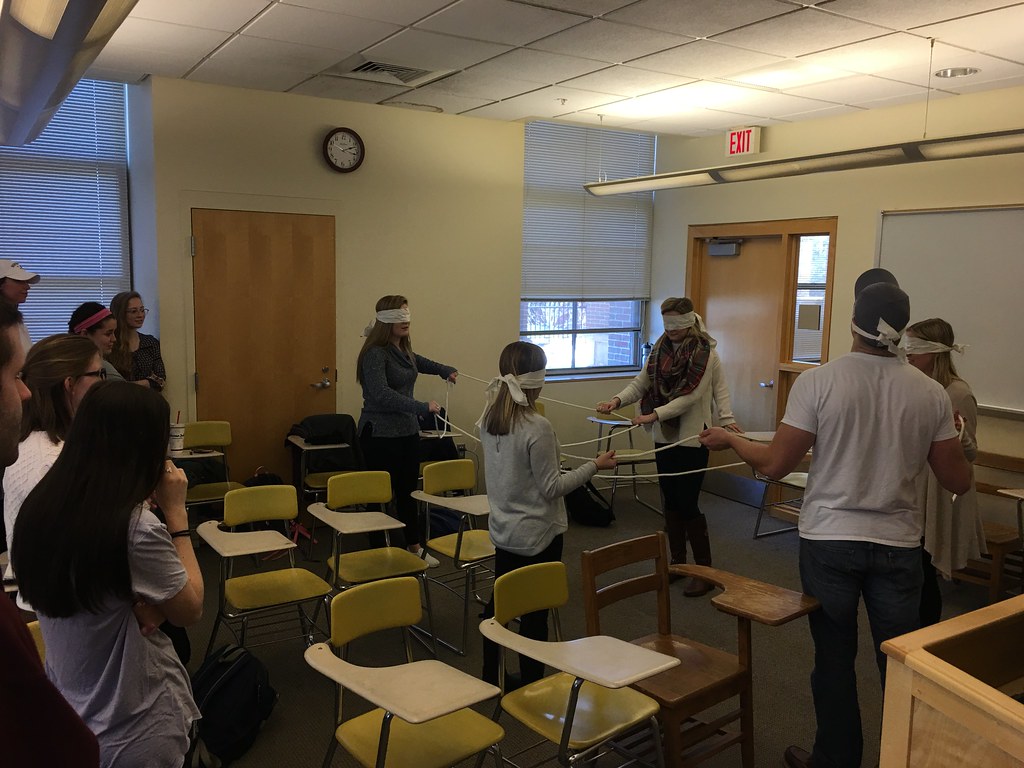
Here they are working through a warm up exercise where they had to contain a reactor meltdown after a tsunami hit the New Hampshire seacoast. Of course they had to wear protective gear while they were so close to the radiation. Luckily they had audio communications with the rest of their team.

I have been drawn to open education primarily because I see it as an opportunity for greater engagement - for the students, and for me.

Unfortunately, I spent most of the class talking at the students about the class. I had hoped to actually have some conversation, but we had relatively little. That's me, reverting to "sage on the stage" type. This is not going to be easy.

They did make decisions about how to assign mentors. It was somewhat arbitrary, but I suppose that is partially because I rushed the issue. Lesson learned there.

Turning the controls over to the students is going to be a challenge for both them and me. I'm still looking forward to the opportunity!


here we go again!

Spring semester starts for me a couple of minutes and I am, as always, excited and nervous for the first day of class. This semester I am trying something completely different - an experiment with Open Education as I have noted previously - so I am excited to try something completely different and a little nervous that it is going to be an epic fail. But that's the nature of innovation - you have to take chances.

As the Army Core of Engineers says, Essayons! Let us try!

Friday, January 13, 2017

article summary: Attributes of Open Pedagogy - A Model for Using Open Educational Resources

For my ongoing article a day for 30 days effort - day 13:
Bronwyn Hegarty, Attributes of Open Pedagogy: A Model for Using Open Educational Resources
https://upload.wikimedia.org/wikipedia/commons/c/ca/Ed_Tech_Hegarty_2015_article_attributes_of_open_pedagogy.pdf
I've chosen this article because I have decided to try "open pedagogy" for my OB class this spring. I'll be looking at a number of articles about employing this educational approach.

Notes:

“Open Educational Practices (OEPs) constitute the range of practices around the creation, use, and management of open educational resources with the intent to improve quality and innovate education” (OPAL, 2011a, p. 4)
Five principles of openness are considered by Conole (2013) to be necessary for OEP, comprising open tools and processes that promote:
(1) collaboration and sharing of information;
(2) connected communication about learning and teaching;
(3) collectivity to grow knowledge and resources;
(4) critique for the promotion of scholarship; and
(5) serendipitous innovation. (Conole, 2013)
 Attributes of Open Pedagogy
1) Participatroy technologies
2) People, openness, trust
3) Innovation and creativity
4) Sharing ideas and resources
5) Connected community
6) Learner generated
7) Reflective practice
8) Peer review